Agree who owns the customer
Choose a pilot region and one commercial objective. Map the parent account, subsidiaries, territories and named account owner. Agree how shared contacts and global opt-outs will be handled before regional teams schedule overlapping messages.
Hand off the execution
We write the sequence, build CRM segments, configure timing and exclusions, prepare test sends and collect approval in one campaign record. Your team appoints one commercial approver and, where needed, a technical reviewer. You approve the content and send window. We handle execution.
Set a revenue baseline before scaling
If doubling repeat revenue is the goal, define the period, cohort and revenue measure with finance. Compare net repeat sales with the baseline and use a holdout when practical. Scale to a second region once attribution, rep handoffs and suppression rules work in the pilot.
Planning your program
Pilot across accounts, not individual contacts
Choose a region with clean account identifiers and a sales leader who can approve exceptions. Keep all contacts at one buying organization in the same pilot group. Otherwise one contact can receive the campaign while their colleague is supposed to be in the comparison group.
Set rollout criteria with sales operations
Before the first send, agree on eligible accounts, who approves each language version, how quickly sales should handle replies and which system confirms a booked order. At the end of the cycle, review missed handoffs and opt-out processing alongside revenue. Assign an owner to each fix before expanding to another business unit.
Define ownership before importing records
Large programs often have more than one CRM and several regional definitions of an active account. Agree which system controls company identifiers, contact permission, sales ownership and completed orders. Record how conflicts are resolved. A local unsubscribe should reach the systems that rely on that permission before another campaign is scheduled. A rep changing territories should trigger a review of queued replies. Put one responsible team against each handoff so a failed update has somewhere to go.
A practical approval sequence
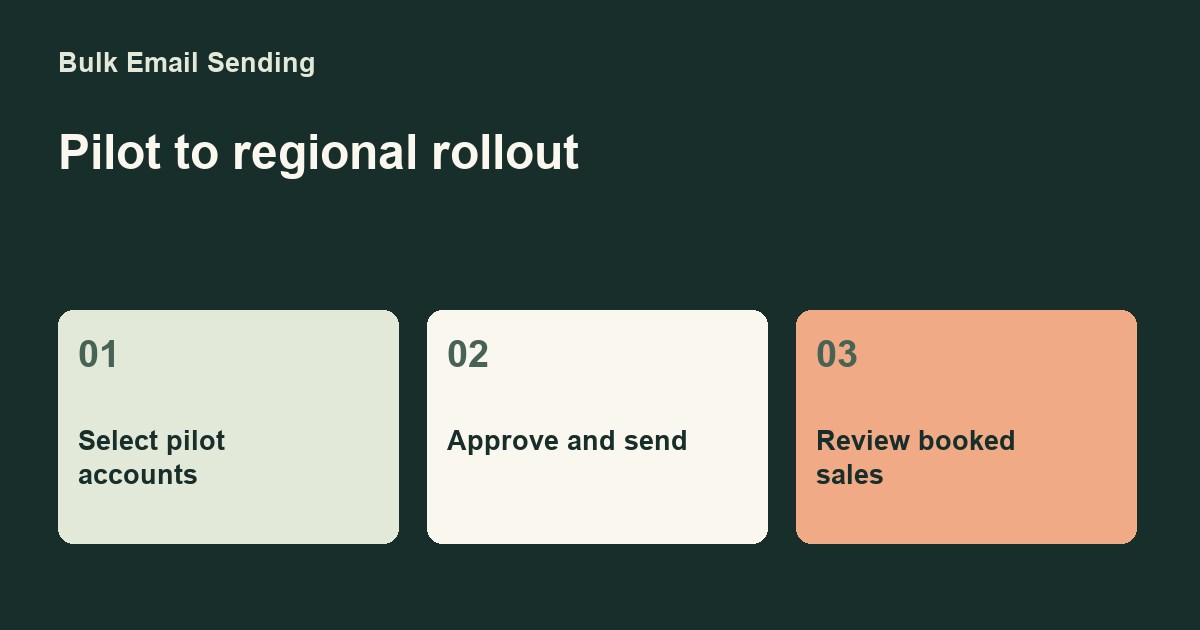
Start with a shared campaign brief covering the commercial goal, the buying stage, exclusions and regional differences. Marketing operations prepares the segment and the technical reviewer checks claims that depend on stock or specifications. A regional approver tests a proof with the exact links and sender identity the buyer will see. Only then does the designated sender schedule the approved version. For a material change, return the updated proof to the person whose approval is affected and record the decision.
Example of a second-region decision
Suppose the pilot generated several promising replies but the regional sales team recorded them in personal inboxes. Before introducing another territory, repair the reply routing and define how those opportunities enter the CRM. Reconcile one complete cycle against booked orders. If the link between the campaign and the sale is still uncertain, keep that uncertainty in the report. This gives leadership a realistic basis for deciding whether the next investment belongs in more sends or better sales operations.
How does an enterprise engagement begin?
A pilot can be scoped from a campaign calendar, aggregate audience counts and a diagram of the systems involved. Agree on the primary objective, who can authorize data access, and which team will take over implementation if the pilot identifies an integration gap. Those decisions determine the work more reliably than list size alone.
 Bulk Email Sending