Calculate the lift against comparable accounts
Use the number of eligible accounts assigned to each group, including those that never opened an email. Comparing only the people who clicked selects the most interested buyers after the fact. Keep a record of the original assignment and flag sales-rep outreach, discounts and stockouts during the observation window.
Check the economics before expanding
In the worked example, the estimated extra revenue is $4,000 across 100 emailed accounts. At an illustrative 30% gross margin, that is $1,200 before campaign costs. Subtract creative, platform and management costs before deciding to extend the pilot. A revenue lift can still leave little contribution if the offer relied on a deep discount.
Pick the comparison before sending
Choose a repeat-order window long enough to cover a normal buying cycle. Randomly assign eligible accounts to the campaign or a holdout and keep contacts from the same business together. Both groups should receive normal transactional messages. Record promotions or sales outreach that could affect the comparison.
Work with net revenue per account
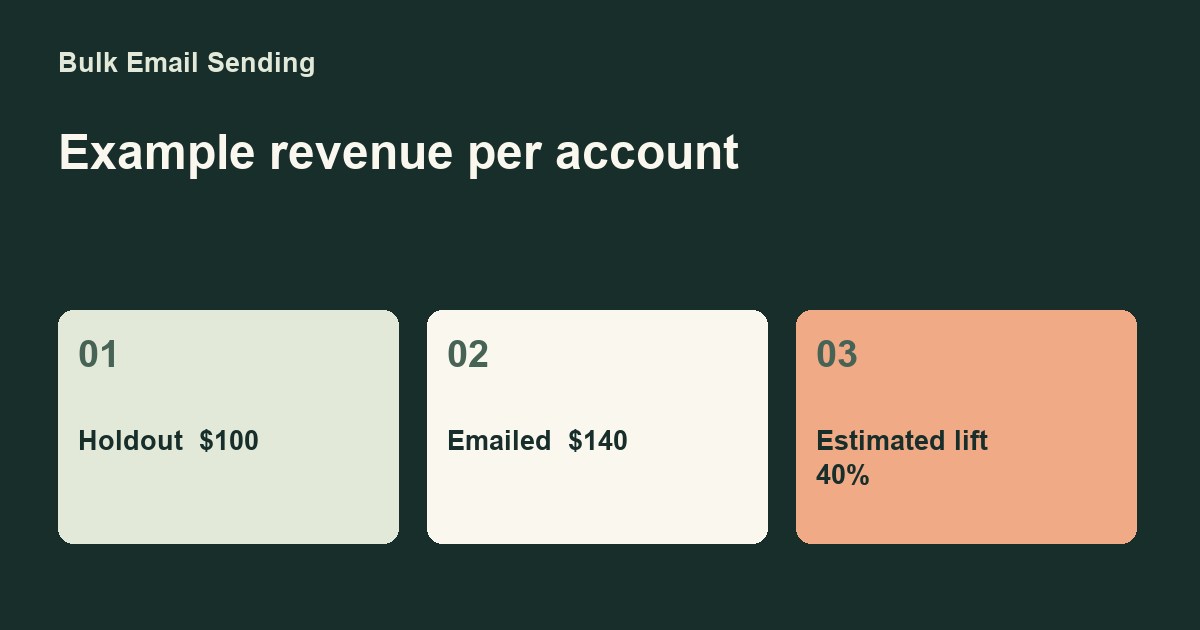
Suppose 100 emailed accounts generate $14,000 and 100 holdout accounts generate $10,000. That is $140 versus $100 per account, an estimated lift of 40%. Doubling on this measure would require $200 per emailed account against the same $100 baseline. These numbers are illustrative.
Decide what counts as success
Reconcile returns, discounts and cancellations. Check whether one large purchase explains the difference. For a small pilot, repeat the test over another cycle before claiming a stable effect. Report campaign-attributed revenue and estimated incremental revenue as two distinct measures.
Define the sale before the campaign starts
Write down what qualifies as repeat revenue. For a trade account, that might be the net value of fulfilled repeat orders from any branch during a fixed purchasing window. Agree how you will handle taxes, freight, credits, partial shipments and orders that were already open at assignment. Use the same rule for both groups. A sale entered by phone can count if the definition includes phone orders and the account can be matched reliably.
Record the opening and closing dates with the time zone. Leave time for finance to reconcile credits before presenting a final estimate. When an early result is needed, label the extraction date and explain which adjustments are still outstanding. That lets sales review a timely figure without confusing it with the number finance will use later.
Protect the comparison during the pilot
Give the person scheduling the campaign a saved list of assigned accounts. If someone unsubscribes, honor the choice and keep the account in its original group for the analysis. Removing accounts based on what happened after assignment changes the people being compared. Likewise, a holdout account that places an unusually large order still belongs in the holdout total.
Example. Two purchasing contacts at one plant share a budget and forward offers to each other. Assigning one contact to each group would allow a single decision to affect both sides. Assign the plant as one unit if it makes purchases independently. If a head office buys for several plants together, consider assigning the whole purchasing account as a unit and record that choice before drawing the groups.
Check how much one purchase moves the result
In the example above, the dollar difference per account is $40. Suppose one emailed account placed an exceptional $3,000 order during the window. Show the original result first, then calculate how much of the $4,000 difference that order represents. Three quarters of the estimated difference rests on that one sale. That concentration warrants another cycle of observation before using the figure to forecast a larger rollout.
For a formal readout, ask the analyst to estimate uncertainty at the level used for assignment. Orders from the same buyer share a purchasing decision and cannot automatically be treated as independent observations. Keep the account-level totals, including zeroes, so the analyst can reproduce both group averages and inspect the spread of order values.
Explain what changed in business terms
Example management summary. “The emailed group averaged $140 in repeat revenue per assigned account over the agreed window. The holdout averaged $100. Our estimated difference was $40 per account. One large order accounted for much of that difference, so we will repeat the comparison before setting a sales target.” Add the contribution after discounts and campaign costs if those figures have been reconciled. This gives the decision maker the size of the opportunity and a clear reason for the next test.
 Bulk Email Sending