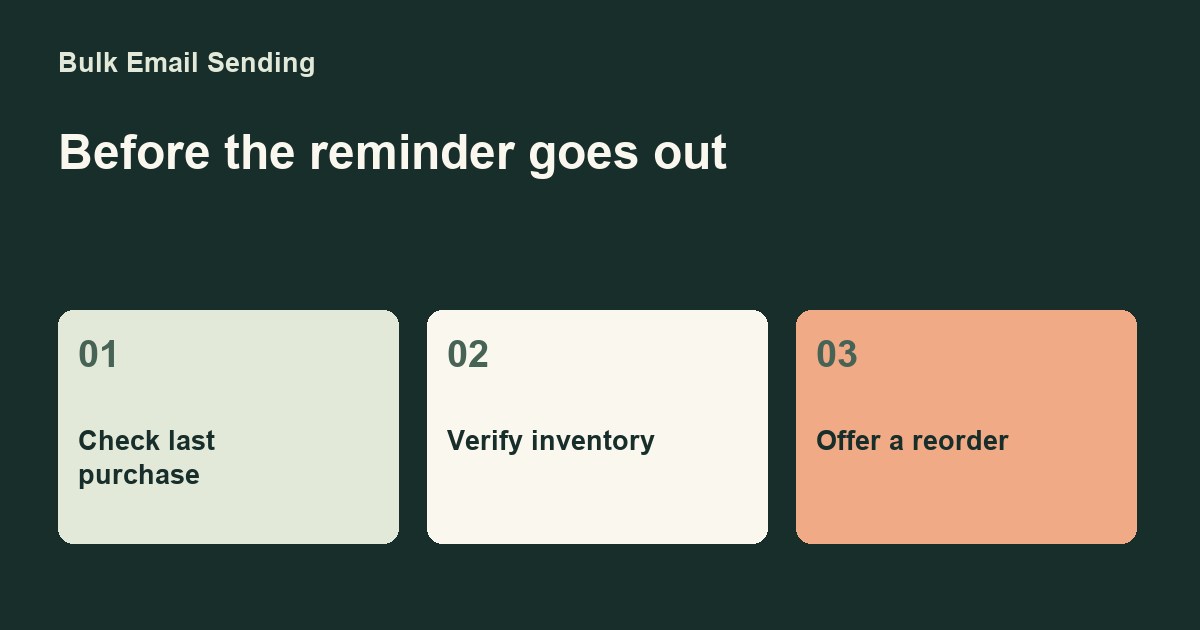
Decide when a reminder would be unwelcome
An account might have ordered unusually early to cover a planned shutdown. A second branch might have already fulfilled the same requirement. Review open orders at the account level and give the branch rep a way to flag exceptional purchases. Start with a narrow list whose invoice history you can explain.
Give the buyer a low-friction reply
Try “Would you like us to check availability for your usual two cases, or is your next order further out?” A reply about timing is valuable even when it produces no order. Record the revised date with the buyer’s permission and use it to prevent another premature reminder.
Calculate the reminder window
Take one account and SKU with a repeat history. If its three most recent intervals were 29, 32 and 30 days, 30 days is a reasonable starting estimate. Check typical fulfillment time with the branch before selecting a send day. Holiday shutdowns or a bulk purchase can shift the interval.
Write the email around the item
A practical subject is “Ready for another case of F-20 filters?” Reference the last pack size and include an easy reply for a different quantity. Use a link to the correct account ordering portal. Avoid assuming that a buyer needs another case simply because a date has passed.
Suppress and learn
Check for a new order immediately before sending. Pause the reminder when the buyer replies or when inventory drops below the quantity offered. Compare fulfilled orders and repeat intervals over several cycles before expanding to another SKU.
Choose an item with a recognizable buying pattern
Start with a consumable that a branch sells repeatedly in a consistent unit. Look at fulfilled invoice lines for the same buying location and item. An invoice correction, a return or a delivery split across two vans can make one purchase look like several. Ask a branch employee to explain any unusually close pair of invoices before using the interval between them.
Example. A workshop buys a case of filters every month and once buys four cases before a seasonal closure. For that account, ask the rep how long the extra stock was expected to last. A date calculated from the ordinary one-case purchases will arrive early unless the exceptional quantity is taken into account. If the rep has no reliable estimate, leave that purchase out of the reminder schedule until the account orders again.
Check who places the next order
A company may have one purchasing office and several delivery sites. Confirm whether the person on the invoice still buys for that location. A warehouse receiving contact can be the right person for a delivery notice and the wrong person for a reorder reminder. Use the contact and subscription records associated with the buying relationship. Give the branch a simple way to correct the recipient when responsibility changes.
For a customer with several sites, name the site the reminder concerns if it helps the buyer place the order. Check that the linked portal opens the right account and that someone with access to more than one location can choose the correct destination. An ambiguous location is a good reason for the rep to ask a question before suggesting a quantity.
Match the message to available stock
Example wording. “Hi Jo, your East Street workshop last ordered one case of F-20 filters. Shall I check stock for the same pack, or are you covered for this month?” The buyer can answer even if they are on a phone and cannot sign into the portal. If the reply asks for a price, route it to the person responsible for that account’s terms.
When the usual item is unavailable, ask the branch whether it can confirm a replenishment date. Offer to check an alternative only if the buyer wants one and someone can verify compatibility. The reminder should never be the moment a customer discovers that the pack size on the order form has silently changed.
Read the first cycle with the branch
Review a few complete histories from reminder through reply, order and fulfillment. Mark early reminders, wrong contacts, changed pack sizes and customers who appreciated a timely stock check. Compare the actual order date with the suggested date for each case. If most buyers already had an open order when contacted, improve the order feed before changing the wording. If one location consistently buys later, adjust that location’s interval and record the reason for the next person who reviews it.
 Bulk Email Sending